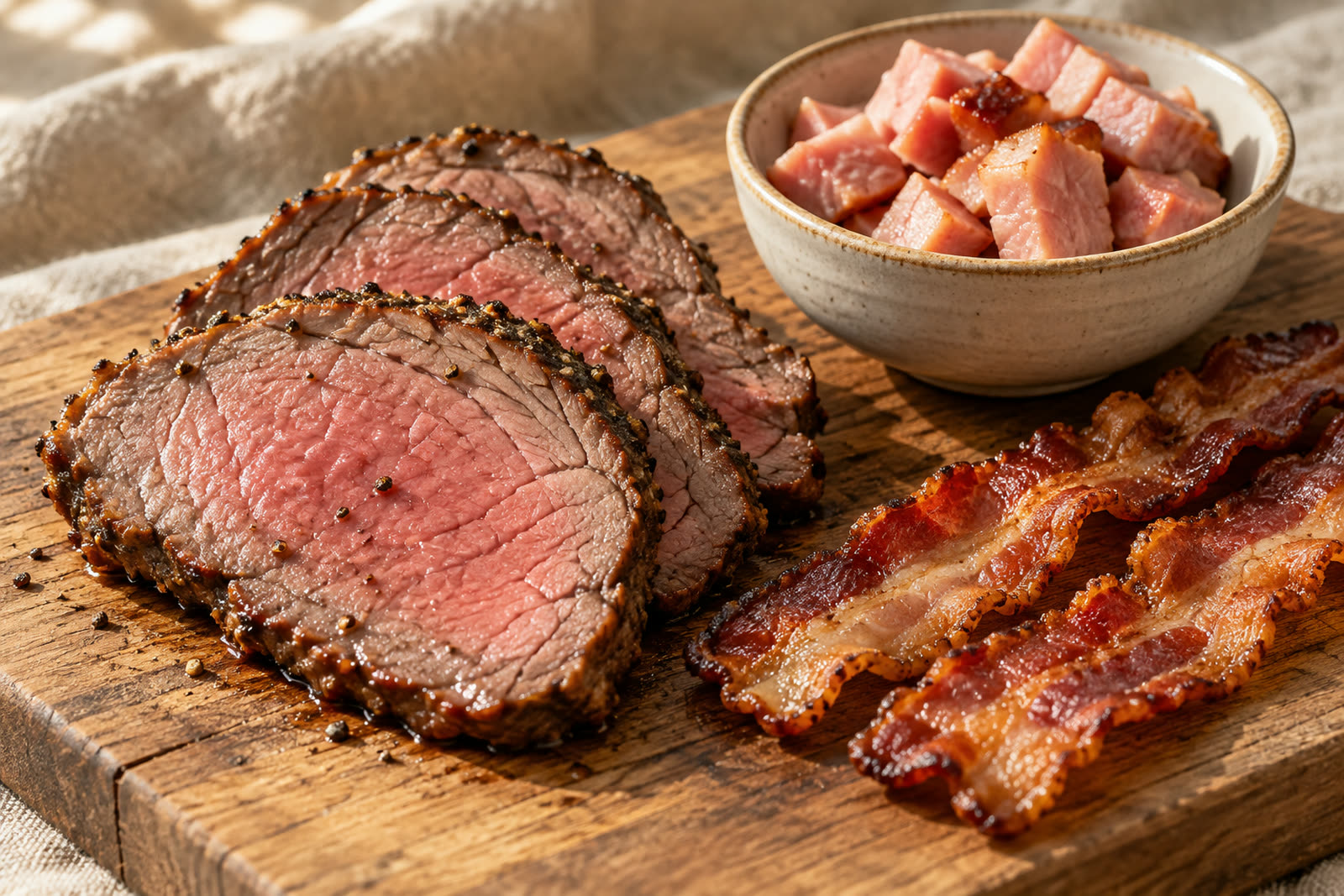
Processed meat causes cancer. It has been printed in a straight line since October 2015, the day the International Agency for Research on Cancer moved it into Group 1, the shelf where tobacco smoke and diesel exhaust sit. Red meat went one step below, at Group 2A. Almost every article since leads with that shelf and stops.
What almost none mention is that four years later a panel of fourteen researchers from seven countries, who had read the same studies in more detail, concluded that adults should carry on eating what they eat now. Not because the evidence was fabricated, but because the effect is small and the certainty low. Both verdicts describe the same research, and the gap between them is the most useful thing this topic has produced in a decade.
What the 2015 classification actually said
Twenty-two experts from ten countries reviewed more than eight hundred studies for IARC, with the weight coming from large prospective cohorts. Red meat was classified as probably carcinogenic on limited evidence in humans plus strong mechanistic evidence, the association seen mainly for colorectal cancer. Processed meat was classified as carcinogenic on sufficient evidence in humans that it causes colorectal cancer.
The number that travelled furthest came from the press release rather than the paper: each fifty-gram portion of processed meat eaten daily increases the risk of colorectal cancer by eighteen per cent. Note what that is. A relative risk, from comparing intake levels across studies, not from a trial. Not a claim that eighteen per cent of daily portion-eaters will develop the disease. One paragraph later the same release says the opposite plainly: for an individual the risk stays small, but rises with the amount consumed. Large in aggregate, small in the singular.
The pooled sizes, decade on
Two recent meta-analyses pin the size down, and they disagree instructively about what they measured. Farvid and colleagues, screening to December 2020, pooled 148 articles comparing highest against lowest intake: red meat came out at a relative risk of 1.10 for colorectal cancer, confidence interval 1.03 to 1.17, processed meat eighteen per cent higher again. Ungvari and colleagues, in 2025, searched from 1990 to November 2024 and pooled sixty prospective studies, landing at 1.15 for red meat and 1.21 for processed.
The newer analysis moved the estimates up rather than down, which is not what happens to noise. Neither figure is the fifty-gram one, though: they compare top against bottom of the intake range, a far wider step than a portion a day. Quoting them as one measurement is not being careful.
What the evidence graders said about the same evidence
Here the story turns. The NutriRECS consortium built five systematic reviews from scratch, rated every outcome with GRADE, and turned the results into recommendations. Their cancer review — Han and colleagues, in the Annals of Internal Medicine the same year — pooled 118 articles from 56 cohorts with more than six million participants.
The finding, in the review’s own summary: three servings a week less unprocessed meat was associated with a very small reduction in overall cancer mortality over a lifetime, on low-certainty evidence. Three servings a week less processed meat, very small decreases in overall cancer mortality, prostate cancer mortality, and incidence of oesophageal, colorectal and breast cancer, on low to very low certainty. Conclusion as stated: the possible absolute effects are very small, and the certainty is low to very low.
Then the panel of fourteen, three of them community members, wrote the recommendations. Continue current unprocessed red meat consumption, weak recommendation, low-certainty evidence. Continue current processed meat consumption, same strength, same certainty. Two “carry on” lines that were the most argued-over sentences in nutritional guidance that year.
Why both verdicts can be honest
A Group 1 classification answers “can this cause cancer in humans”. It does not answer “by how much, for whom, and is that worth changing your Saturday”. Grading answers the second question and found it small and uncertain. Nothing was overturned, nothing was whitewashed. Two questions, one dataset, and only one of them got quoted.
The absolute numbers stay small for a structural reason: these are observational cohorts in which diet is a self-reported memory from a food frequency questionnaire. The reviews name the limits themselves, with residual confounding and recall bias at the top of the list.
What this means on a plate
IARC’s definitions are worth keeping straight, because the two categories behave differently in the data. Red meat is mammalian muscle meat; processed meat is meat transformed through salting, curing, fermentation, smoking or preservatives. A joint and a rasher of bacon are not one food, and the pooled numbers treat them as two.
Nobody in this literature argues for more processed meat. The argument is about volume of voice: say the effect is small and the average reader hears “no effect”; say “carcinogenic” with no size attached and the average reader hears “avoid at any cost”. Both readings are wrong. The neighbouring questions are saturated fat for the fat that arrives with the meat, and ultra-processed food for the classification behind the headlines.
What the data do not show
They do not show that a slice of ham ends a life, and they do not show that unprocessed red meat is neutral either: its association with colorectal cancer is smaller and less certain, but not zero. They show nothing about an individual. Pooled cohort statistics cannot tell any one reader what their plate does, which is exactly the sentence that gets deleted when a headline is being fitted.
The numbers came from the sources in the rail, not from us. If a claim about meat and cancer carries a number, check whether it is relative or absolute, per day or top-versus-bottom, and what grade of evidence stands behind it.