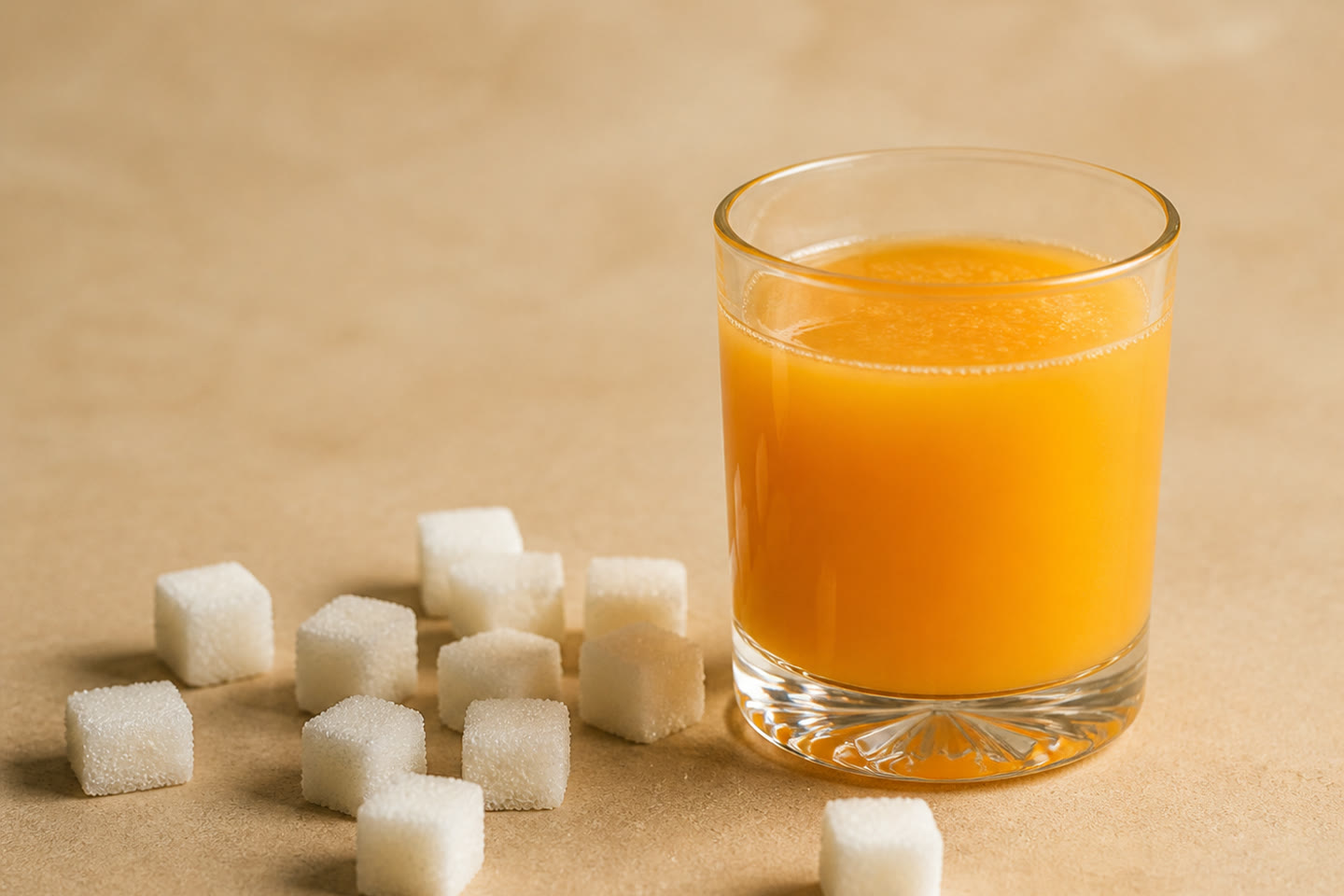
Sugar headlines swing between “poison” and “harmless in moderation” often enough that it’s worth going back to what the main global guideline actually states — because it’s more precise, and more useful, than either headline.
The recommendation
The World Health Organization recommends keeping free sugars below 10% of total daily energy intake — on a typical 2,000-kcal adult day, roughly 50 grams. The WHO adds that limiting further, to below 5%, may bring additional health benefits.
Not zero. Not “sugar is toxic”. A budget.
“Free sugars” is doing the heavy lifting
The guideline targets free sugars: everything added to food and drinks by manufacturers or by you, plus the sugars naturally present in honey, syrups and fruit juice.
What it deliberately does not count: the sugars sitting inside whole fruit and plain milk. An apple’s sugar arrives packaged with fibre, water and the chewing time that comes with eating an actual apple. Juice the apple, and its sugars move into the “free” column — that’s the logic behind the juice line, and it surprises most people the first time.
Where a 50 g budget actually goes
The budget rarely disappears into the sugar bowl. It disappears into:
- Sweetened drinks — the single largest and least satiating source; one large glass of a soft drink or juice claims a big share of the day
- Breakfast cereals and flavoured yogurts — foods marketed as sensible
- Sauces and dressings — ketchup and friends, small amounts that add up
A day of ordinary processed food can spend the budget before dessert is ever discussed.
The practical reading
- Drinks are the highest-leverage change — moving from sweet drinks to water, coffee or tea rewrites the arithmetic on its own.
- Whole fruit is not the enemy; the guideline explicitly leaves it alone.
- The label line to check is “of which sugars” — more on reading EU labels in our label guide.
One number, one definition, and most of the shouting evaporates.