Two numbers get printed on essentially every peptide certificate of analysis, and almost nobody on the internet understands the difference between them. They are purity and content, and swapping them produces a document that reads well and means nothing.
Then there is a third thing, chirality, that most certificates do not mention at all and that a properly built laboratory can measure to within a tenth of a percent. This page takes the three apart, and explains why a 2023 paper on reference standards is the more useful of the two documents cited here.
Purity: how much of this thing is the right thing
Purity is a percentage, and the correct reading is: of the material in the product, this share is the compound whose name is on the label.
The word that does the work is “of the material”. Purity is a ratio. It says nothing about how much material there is. A vial can be 99 % pure and contain almost nothing, and it will still be 99 % pure.
This is why the figure is usually quoted as a high number. Once a synthesis and purification process is running, purity is the parameter that is easiest to push up and hardest to fake, because pushing it up costs yield. Certificates reporting values above 95 % are not remarkable; they are what a working purification process produces.
Content: how much of the right thing is actually in the vial
Content is the other half, and it is the one that answers the question a buyer actually has. It is a mass, not a ratio, and it is what the 2023 Pharmaceutical Research paper is about.
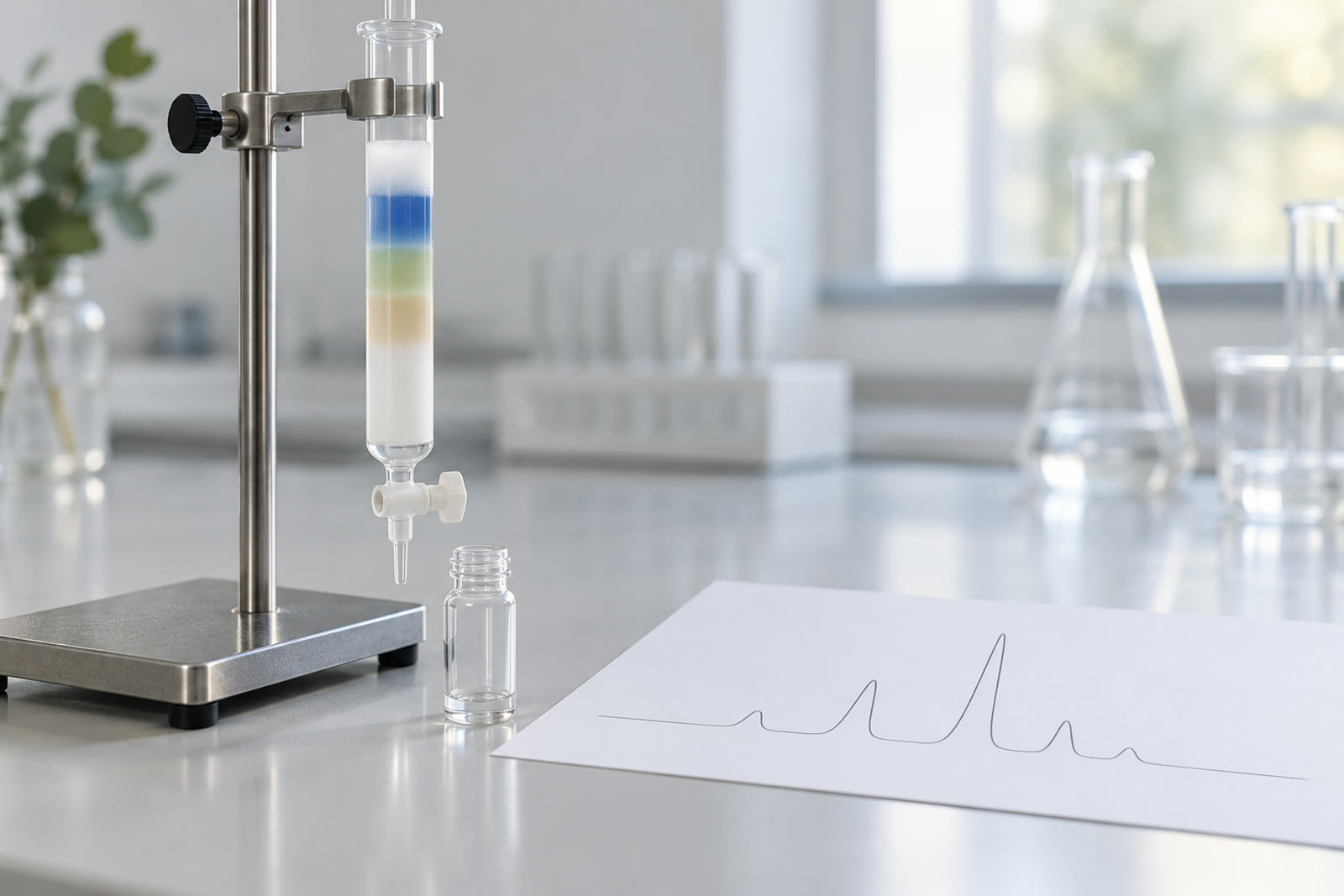
The paper’s subject is reference standards — the characterized materials a laboratory measures an unknown sample against. Without a standard of known value, an HPLC trace is a picture with no scale on it. The paper describes how those standards are produced, and the part that matters for reading a certificate is the two-step value assignment:
- a mass-balance approach assigns a quantitative value to bulk peptide material;
- the bulk material is then used as the standard that assigns a final value to the vialed material.
Then identity is confirmed and the vialed material is checked for consistency, with stability studies alongside to handle variability and outliers.
Three words in that description are the whole article: content uniformity. It is a distinct test from purity, it is a distinct test from identity, and a certificate that reports only purity and identity has not told you whether the contents of the vial are uniform — whether pulling solution from the top and the bottom of the vial gives you the same thing.
Chirality: the test that usually isn’t on the certificate
Here is the part that separates a real analytical report from a marketing document.
A peptide and its mirror image have the same mass. Any method that works by measuring mass cannot tell them apart. But a synthetic peptide can carry unwanted D-amino-acid substitutions — introduced as impurities in the amino acid starting materials, formed during synthesis, and in some cases during shelf life — and a peptide built from the wrong handedness of its building blocks can be chemically perfect and biologically inert.
The 2023 method in the Journal of Chromatography B handles this properly. Two design choices in it are worth copying as a reading standard for any certificate you are handed:
- The peptide is hydrolyzed in deuterated acid, specifically to correct for racemization that occurs during sample preparation. Without that correction the laboratory measures its own handling as much as the product. This is the single most under-appreciated line in analytical chemistry: a number you cannot separate from your own method is not a number about the product.
- The method’s GMP validation feasibility is described for all nineteen chiral proteogenic amino acids, and the practical demonstration recovered D-amino-acid substitutions at each residue of an octapeptide across the 0.1–1.0 % range, applied to four model peptides of 8 to 14 residues.
Nineteen amino acids validated and a stated detection floor is what an analytical claim looks like when it is made by somebody who expects to be checked.
What a certificate therefore proves, in order
Assembling the three:
| the certificate says | it establishes | it does not establish |
|---|---|---|
| identity, by a named method | it is that compound | that it is the right form |
| purity above a stated figure | the share that is the compound | how much compound is present |
| content / content uniformity | how much is in the vial, and whether it is even | that it works |
| D-isomer percentage, if present | the building blocks are the right handedness | that it reaches any tissue |
The last column is where the marketing lives, and it is the column nobody reads.
A worked example of why the distinction bites
Two certificates, both reading “98 %”.
Certificate A: purity 98 %, content not stated, no method names beyond “HPLC”.
Certificate B: purity 98 % by a named method against a characterized reference standard with a two-step value assignment, content stated in milligrams per vial, D-isomers below 0.1 % across all nineteen residues, and a stated stability indicator.
Both say 98 %. Only one of them tells you what is in the vial. And a reader who treats both as “98 % pure, therefore a good product” has learned nothing from either — the number was the easy part.
For how a laboratory actually certifies that content figure, and what a mass-balance assignment has to rule out, the walkthrough at how peptide purity is measured covers the method in more detail than fits here.
What none of this shows
None of it shows that the peptide works. Nothing on a certificate is a biological endpoint. A perfectly characterized, perfectly pure, perfectly uniform, perfectly handed compound can have no measurable activity in a human. That is a separate study with its own separate design.
None of it shows that the compound reaches the tissue you care about. Certificates describe the vial. Distribution, stability in blood, and clearance are all measured elsewhere.
None of it shows the shelf life, unless the report carries a stability study or a stated retest date. A certificate describes one lot, on one day. A 2023 paper that treats stability studies as a distinct piece of work makes the same point structurally: the vial you receive is not the vial that was tested, unless somebody tracked the difference.
None of it shows that a second laboratory would get the same number. Method validation across laboratories is a separate exercise, and a report that names its method — rather than only its result — is the minimum precondition for the question to be askable at all.
The four questions, in order of usefulness
If you want one short list to apply to any certificate:
- Is purity given as a method or as a number? “HPLC, 98 % against a characterized standard” and “purity: high” are not the same kind of statement.
- Is content stated, and separately from purity? A certificate with no content figure has not told you what is in the vial.
- Is content uniformity addressed? Non-uniform contents make every other figure on the page approximate.
- Are D-isomers addressed, and against what detection floor? A peptide and its mirror image have identical mass, so a certificate that reports only mass has not looked.
Four questions, and the fourth one separates a laboratory report from a brochure.